
.jpeg)
The search for top tech talent is not about simple recruitment anymore. It is a matter of real business agility and long-term survival. Entering 2026, companies aren’t just looking for coders or data scientists, they’re re-thinking the entire framework of talent strategy, combining high-value outsourcing, automation, and in-house upskilling at a scale never seen before.
Today’s winners? They have stopped waiting around for local unicorns. They are sourcing globally and focusing on strategies that drive business value and innovation. It is no longer about who can pay the most, but who can move the fastest.
“Outsourcing is now about access to rare skills, flexibility, and rapid scaling. Cost comes second.”
Outsourcing is moving up the value chain, from simple cost-saving to a mission-critical business need. Visionary leaders now partner with expert providers, such as SDC LEKA, who deliver deep specialization, agile talent networks, and the ability to drive transformation locally and globally. Smaller businesses, too, can now compete globally by “tapping out” the skills gap through smart partnerships.
A new trend? Talent marketplaces and AI-fueled sourcing tools are upending old recruitment. Platforms match businesses with niche developers, UI/UX pros, DevOps, or even fractional CTOs, all on-demand.
Talent wars are fierce, especially for skills in AI, cybersecurity, advanced software, and cloud engineering. The best companies are responding by adopting hybrid sourcing models that blend onshore, nearshore, and offshore teams, creating a seamless, always-on collaboration network. This model lets businesses stay productive around the clock and access expertise across continents.
Another powerful shift is seen in the adoption of AI-augmented services. Companies automate repetitive tasks and free up their top minds for true innovation, creative problem-solving, and high-value project delivery. AI now enables faster onboarding, automated project handoff, and real-time measurement of partner performance and engagement.
Results-driven contracts are critical. Instead of billing by the hour, forward-thinking leaders demand outcome-based agreements: deliver working software, business leads, analytics reports, or digital products on a tight timeline and with clear value.
Transparency in remote delivery is expected. Leaders now require real-time dashboards, detailed progress tracking, and responsive service, with KPIs embedded directly in every outsourcing engagement.
“Globally, 82% of decision-makers plan to increase AI and automation budgets to support next-gen workforce strategies in 2026.”
There are simply not enough qualified engineers, DevOps specialists, or data experts to go around. The “people gap” is now routine, not the exception, in digital transformation. That’s why top players don’t just hire more, they build smarter networks:
The new best practice? Avoid transactional outsourcing in favor of trusted, collaborative partnerships. Build a rich network that flexes as business needs and customer expectations change.
“Nearshore teams in aligned time zones will power deeper collaboration and solve old communication gaps, effectively blurring the old line between ‘outsourced’ and ‘in-house’. Local law and compliance are much easier, team culture is stronger, and innovation cycles shorten.”
AI-Powered Upskilling & Internal Mobility Strategies
The most adaptive businesses in 2026 are investing equally in external talent and the upskilling of internal teams using AI-powered platforms. The focus is on agile learning, dynamic roles, and strategic mobility.
The result: less time wasted, less hiring churn, and more opportunities for non-traditional candidates or freelancers to shine. The company becomes a magnet for continuous learners and a hub for ambitious specialists worldwide.
Employees are not “locked” into static org charts. Cross-project mobility, upskilling, and rotating leadership roles drive faster career progression, deeper engagement, and more resilience when conditions change.
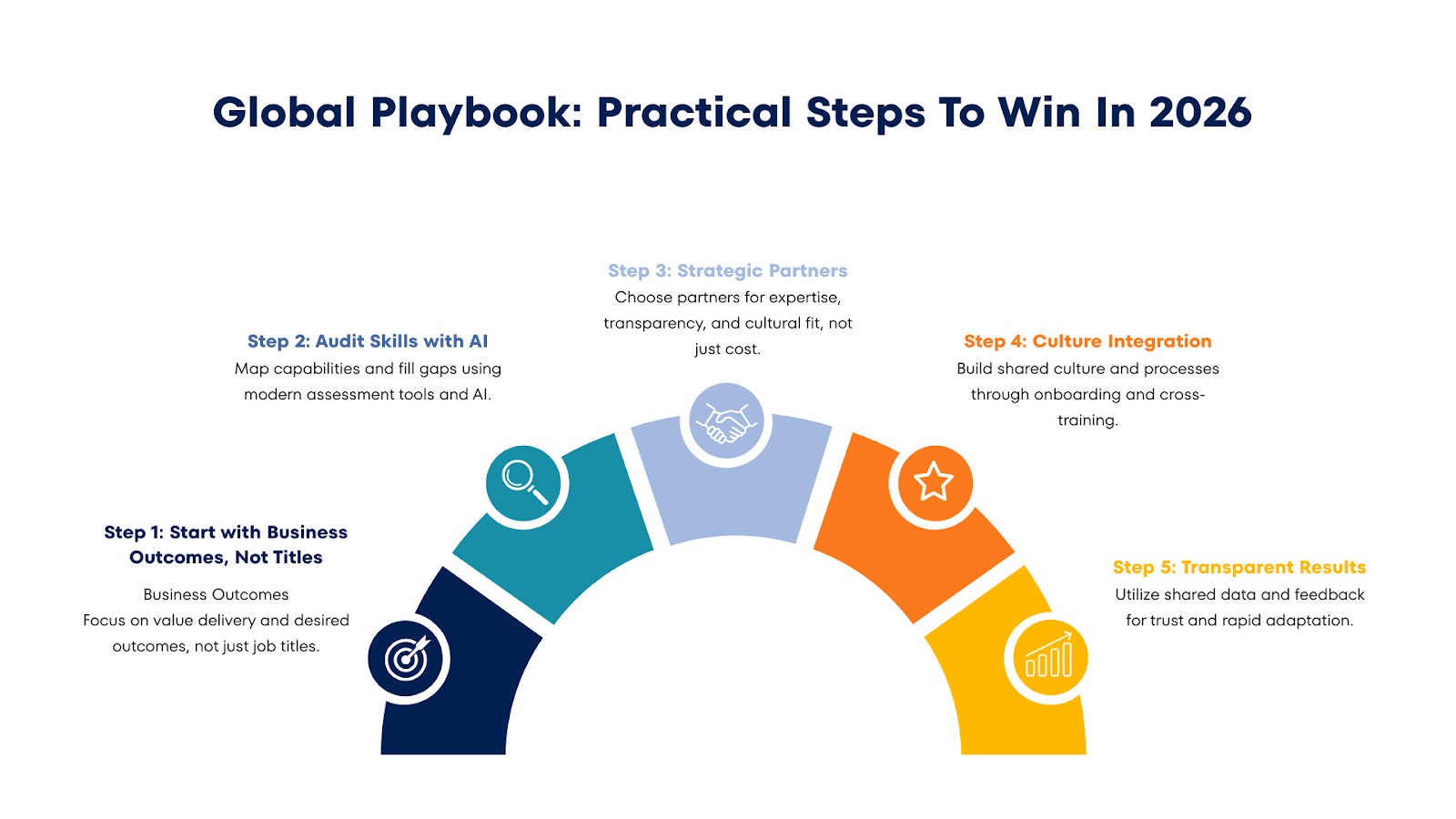
Step 1: Start with Business Outcomes, Not Titles
Don’t list open roles for “engineers” or “analysts.” Instead, map pain points: What business value must be delivered, and what mix of technical or creative expertise will make that happen?
Match requirements to global and local talent pools, then design the right sourcing mix.
Step 2: Audit Skills and Map Gaps Using AI
Use modern assessment tools and project tracking to create a live snapshot of capabilities and needs. Plug the holes with upskilled internal resources, partners, or high-value contractors.
Step 3: Choose Strategic Partners, Not Lowest-Bid Vendors
Assess prospective partners on expertise, employee stability, security, and time zone/workflow fit. Prioritize agencies and individuals known for transparency and knowledge transfer, not black-box delivery.
A clear due diligence checklist can prevent costly misfires.
Step 4: Build Integration and Culture Up Front
Plan for onboarding processes, shared playbooks, and regular skills/leadership exchanges. Invest in team meetups and cross-training, whether digital or in person to support shared culture and reduce friction.
Step 5: Use Transparent Results and Trust, Not Just Contracts
Power up every partnership with shared dashboards, product demos, and feedback loops. The more data flows, the faster you can adapt to new needs and challenges.
The era of permanent, on-site tech teams is ending. For growing businesses, flexibility is the ultimate competitive advantage. Companies offering remote-first, project-based, and hybrid roles will attract the best talent faster. It is less the case now concerning remote position in the tech world as we all see. Partners across the globe whether from Paris, Miami, or Bangalore can be full contributors overnight.
Retention will favor businesses that offer upward mobility, access to cutting-edge learning resources, and visible pathways from junior to senior roles (across departments and borders). This model also enables hiring the “perfect fit” for a critical project even if they’re two time zones away or working part-time.
Companies that blend their internal star players with certified, vetted experts and thought leaders regardless of geography will deliver results with less risk and greater speed. Global reach with local culture, efficiency, and governance creates business resilience fit for now.
Whether you’re an entrepreneur leading a brand-new startup, a scale-up pushing toward your IPO, or the CIO of a global enterprise, your approach to building tech teams is business strategy.
Local or global, in-house or outsourced, the future belongs to those who balance trust, transparency, and data-driven decision-making in every partnership.
Outcomes will always beat location. Flexible workforce design and dynamic, blended skills networks will empower the next decade of digital leaders across industries and business sizes.
At SDC LEKA, we help companies of every size launch agile tech-talent strategies and accelerate transformation through AI and smart automation. Drawing on a global network of trusted experts, robust platforms, and the latest talent tech, our teams are ready to turn business vision into operational wins, blending human expertise with intelligent technology to drive measurable outcomes in growth, efficiency, and innovation.
Connect with us to talk through concrete playbooks for your sector, because in 2026 and beyond, every business is a global talent business.

Dolores Crazover is a transformational Software & AI Engineer and the founder of SDC LEKA, a competitive IT services company driven by the power of Innovation.
SDC LEKA helps businesses grow smarter and strengthen operations through AI, automation, human-centered design, and access to elite tech experts revolutionizing how organizations operate and how people experience technology.
With a background in science and engineering and a career built at the intersection of technology, strategy, and impact, Dolores has led global initiatives across health & beauty, luxury, consulting, fintech, and digital innovation. She has co-founded several ventures, including an AI- and VR-driven wellness platform that delivered intelligent B2B experiences for global beauty and health brands.
As a tech founder at heart, she has co-built international AI communities spanning 30 chapters (including Miami), connecting founders, developers, investors, and partners to collaborate and shape the next wave of intelligent innovation.
Passionate about bridging technology and entrepreneurship, she guides innovation leaders and cross-functional teams, from emerging ventures to global organizations to scale with purpose, turning bold ideas into meaningful impact. Beyond business and technology, Dolores finds inspiration in nature, music, and the quiet beauty that fuels creativity and wonder.

.jpeg)
.png)
.svg)
