
/ All articles
.jpeg)
Digital transformation isn’t a buzzword; it’s the make-or-break challenge of the coming year and the decisive battleground for ambitious companies facing a volatile landscape of customer expectations, competitive talent, and never-ending waves of new technology. As 2026 approaches, winners and losers are no longer separated by who has the biggest IT budget, but by who acts smart and fast to modernize their core data foundation. Indeed, the key to actionable, sustainable digital change is data modernization.
Many organizations still make a classic mistake: they launch pilot projects in AI or install the trendiest SaaS solution, hoping for fast results, only to find stubborn legacy data silos, clunky infrastructure, and process fragmentation standing in the way. Without reworking how you manage, move, and activate your data, real transformation simply doesn’t stick.
Today’s leaders in digital transformation are rewriting the playbook. They’re stepping back from the tech “shiny object syndrome,” instead focusing investments on where they move the needle, integrating and leveraging high-quality, up-to-date, and unified data to enable innovation everywhere in the business.
"Over half of CEOs now see business gains from digital investments, but only when built on a single, up-to-date foundation of integrated, usable data."
What, exactly, stands in the way? It’s the real-world blockers: legacy core systems, data scattered across shadow IT and aging databases, and teams spending hours each week wrangling spreadsheets just to get a partial answer. These are not just annoyances; they’re the invisible reason why digital investments often fall flat.
Right now, market leaders, from global banks like HSBC to pioneers in digital-native retail, are prioritizing cloud migration, hybrid data architecture, rapid integration, and workflow automation as the strategic pillars of their transformation roadmaps. They are creating streamlined, cloud-first, and API-driven environments so every business unit, sales, operations, marketing, compliance, HR can tap into a single source of truth with self-service tools.
“Decision-makers are re-thinking what 'transformation' means: it’s less about adopting every shiny technology, and more about preparing the business for an era of fast, intelligent, data-driven adaptation.”
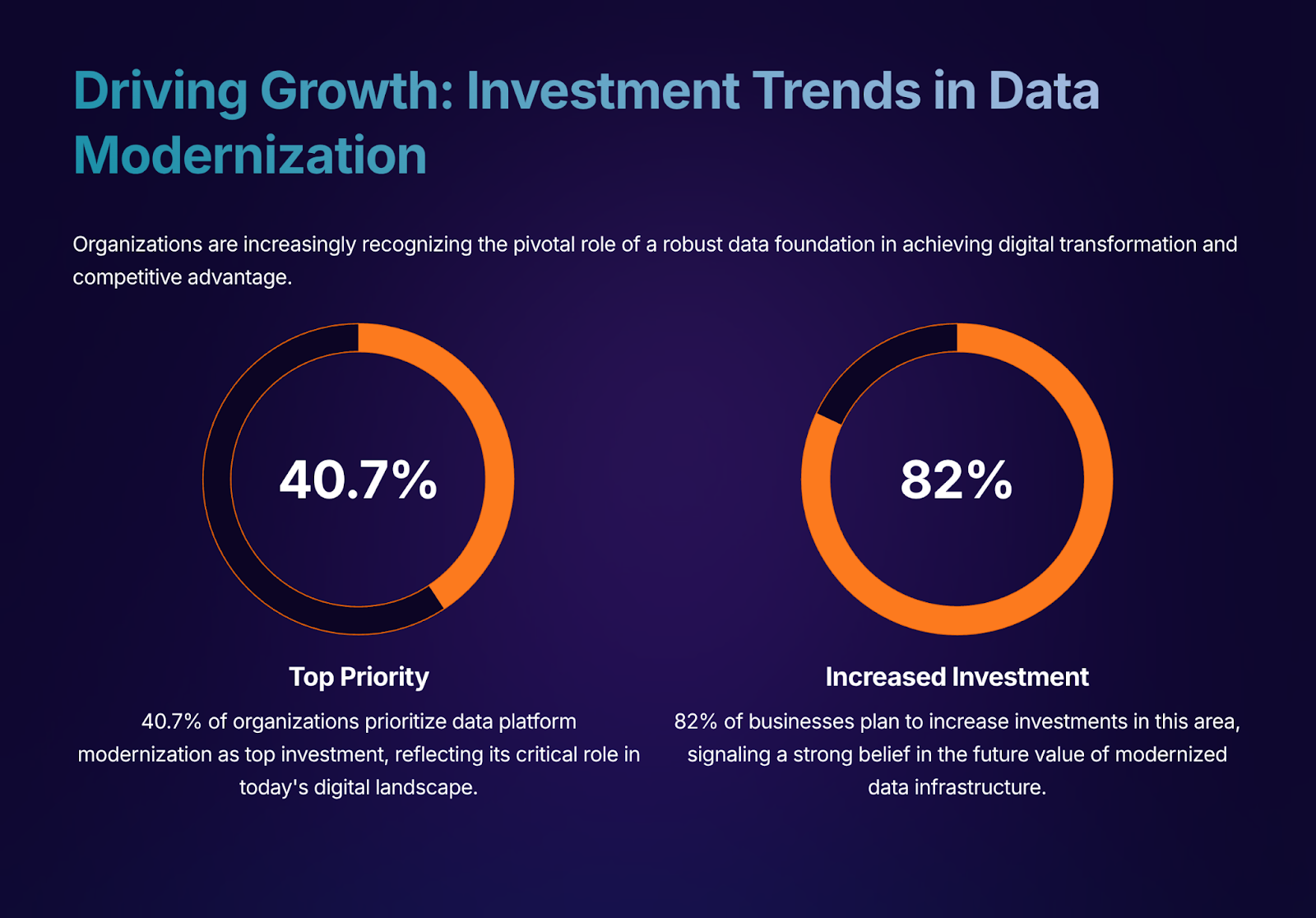
And here’s the proof point: According to Forbes, data platform modernization is now the top data and analytics investment priority for 40.7% of organizations. Even more striking, 82% of businesses plan to increase their investments in this area, recognizing that competitive advantage no longer comes from random tool adoption, but from intelligent, connected, and action-ready data. Following their lead is no longer a recommendation; it’s a must for every company hungry for durable digital ROI.
Modern data platforms unlock:
"Transformation isn’t about adopting AI first. It’s about unleashing teams with trusted, high-quality data so the right ideas scale quickly to production."
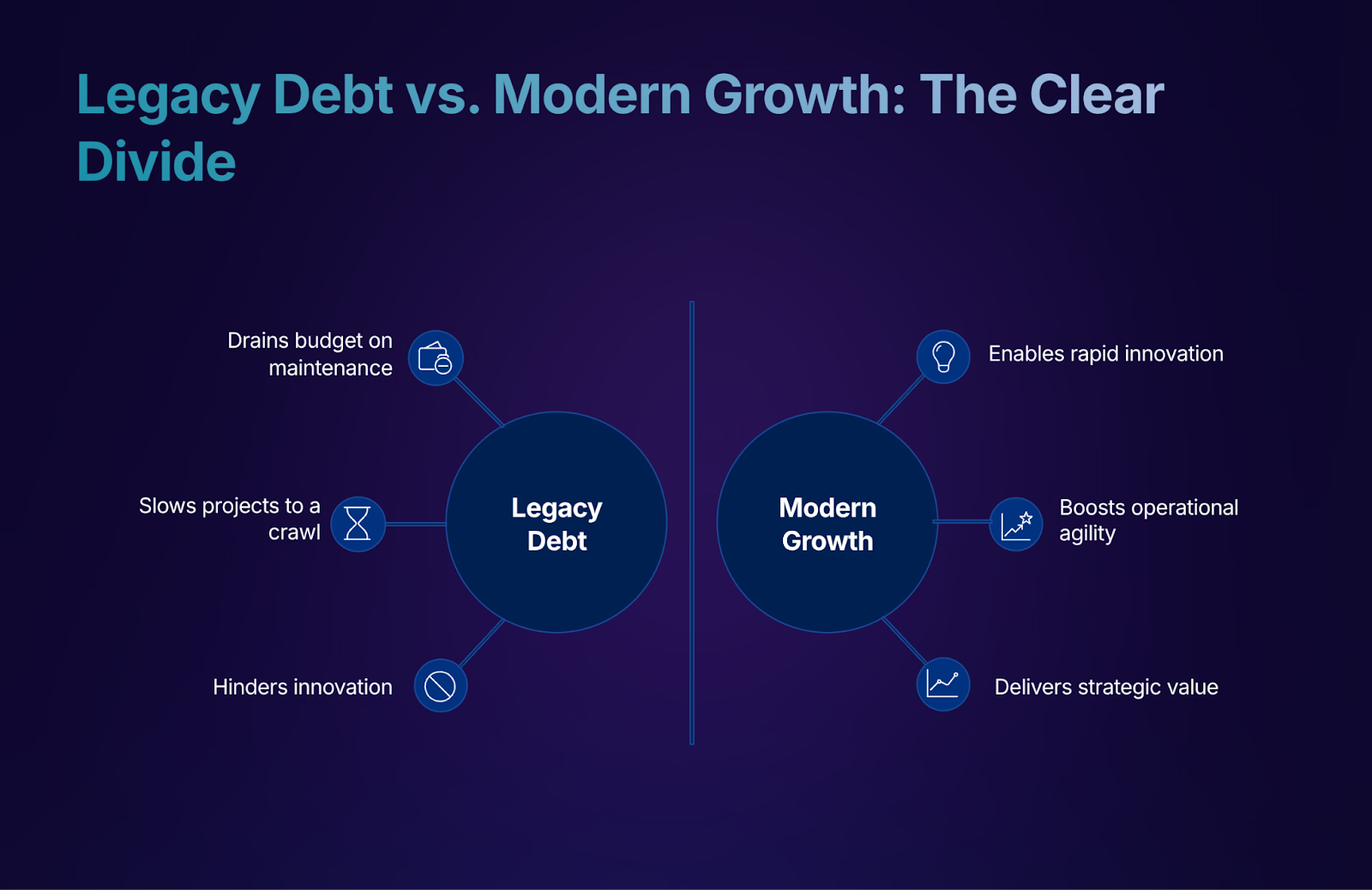
Legacy technical debt has always been costly, but today it’s existential. In 2026 markets, the slowest companies, not just the smallest, are indistinguishable from those left behind. Bloated systems drain budget on maintenance, slow down every project calendar, and force your best engineers into firefighting instead of building.
But modernization is more than a technology upgrade. High-impact transformation efforts prioritize:
Consider Australia Post, which went through a complete cloud migration and data clean-up program. The result? IT overhead shrank, customer-facing digital innovation accelerated, and the organization was able to launch new mobile and logistics solutions in record time, setting the pace for an entire industry. Their story shows that any determined enterprise, regardless of sector, can use the same blueprint to reallocate resources from survival to innovation.
One universal lesson: no digital project achieves lasting value if employees are left behind. The organizations moving fastest are those that blend user-focused tools like no-code dashboards, personalized reporting, and automated communication channels, with ongoing, role-based digital learning for every team member.
Change is not just tolerated but embraced when leaders clearly communicate “why” and “how” modernization unlocks everyone’s growth. Regular hands-on training, collaborative digital forums, and cross-functional agile squads are now standard in top-performing organizations. The entire organization starts moving as one, with shared digital confidence and curiosity.
"You don’t just automate existing habits, you transform them. The future belongs to people-first cultures, powered by digital confidence and fluency."
Begin by mapping every system, workflow, and major dataset. Where is data duplicated, out-of-date, incomplete, or stuck in proprietary formats? What are the unavoidable bottlenecks that slow teams across the business?
Create a clear, phased migration plan:
Analytics and AI are no longer reserved for IT and data scientists. Leading digital organizations train, and empower every department with self-serve data tools, visualization dashboards, and results-focused learning. Your goal: democratize data-driven action, so every stakeholder can run experiments and uncover opportunities.
Build automation into every process, onboarding, reporting, supply chain tracking, customer service, finance, and compliance checks. Invest in integrated access controls and alerts to manage privacy, security, and compliance by design.
The recognition of improved efficiency, lower error rates, higher NPS, or creative internal solutions drives enthusiasm for ongoing adoption. Publicize case studies internally, rotate agile leadership, and keep momentum going with visible, data-backed stories.
When robust, unified data enables every business function, transformation is no longer a project, it’s a continuous capability. Decision timelines shorten, new revenue models can be tested in weeks, and the entire organization can pivot to meet customer and supply chain shifts, even as the market changes overnight.
"The winning companies in 2026 will be those who made data, not just technology, their main engine for growth."
Standing still has never been riskier. As disruption accelerates, whether in market competition, compliance regimes, talent flow, or customer behavior, only organizations committed to real data modernization will be able to keep up, or even set the pace.
True digital leaders combine next-generation technology with relentless investment in people and process. They focus less on chasing trends and more on building a culture and system ready for whatever comes next in 2026 and far beyond.
At SDC LEKA, we guide businesses to unlock next-generation data and future-proof their digital transformation. Our team blends cloud, AI, and integration expertise to help you secure business outcomes that last. Connect with us for a consultation, and stay tuned to our blog for actionable insights on digital transformation, technology, and scalable innovation.

Dolores Crazover is a transformational Software & AI Engineer and the founder of SDC LEKA, a competitive IT services company driven by the power of Innovation.
SDC LEKA helps businesses grow smarter and strengthen operations through AI, automation, human-centered design, and access to elite tech experts revolutionizing how organizations operate and how people experience technology.
With a background in science and engineering and a career built at the intersection of technology, strategy, and impact, Dolores has led global initiatives across health & beauty, luxury, consulting, fintech, and digital innovation. She has co-founded several ventures, including an AI- and VR-driven wellness platform that delivered intelligent B2B experiences for global beauty and health brands.
As a tech founder at heart, she has co-built international AI communities spanning 30 chapters (including Miami), connecting founders, developers, investors, and partners to collaborate and shape the next wave of intelligent innovation.
Passionate about bridging technology and entrepreneurship, she guides innovation leaders and cross-functional teams, from emerging ventures to global organizations to scale with purpose, turning bold ideas into meaningful impact. Beyond business and technology, Dolores finds inspiration in nature, music, and the quiet beauty that fuels creativity and wonder.

.jpeg)
.png)
.svg)
